
Agents Grow Up: Microsoft's Push Toward Production
Two Microsoft moves on autonomous agents, read for small-business operators
 Brendan Tack·
·
5 min read
Brendan Tack·
·
5 min read
Agents Grow Up: Microsoft's Push Toward Production
This week Microsoft made two moves worth your attention. It introduced a new harness for Copilot Studio, framed around more powerful agents and workflows for autonomous business processes. Alongside that, its developer blog published guidance on building production-ready agents with the GitHub Copilot harness and Agent Framework. Together they hint at a direction: agents shifting from experiments toward tools meant to run real work. We are not telling you to adopt anything today. We are flagging what the announcements say, so you can judge the pace for yourself.
Two developments worth your attention
Two Microsoft moves on autonomous agents, read for small-business operators
More powerful agents and workflows for autonomous business processes: Introducing a new harness for Copilot Studio - Microsoft Community Hub
Microsoft describes a new harness for Copilot Studio built for more powerful agents and workflows aimed at autonomous business processes. The summary itself is the whole claim, so treat the specifics as vendor framing rather than proven results. For a small-business operator, the phrase autonomous business processes is the part to watch, because it points at software that acts, not just answers. What that means in your context depends on tasks you would actually hand over. We cannot confirm capabilities, pricing, or reliability from this announcement alone, and neither should you until you test it. The framing signals intent, not delivery, so hold your judgement until real use is possible. Treat this as an early marker of direction and let your own trials, not the announcement wording, decide whether it earns a place in your work.
Read the source →Build Production-Ready Agents with the GitHub Copilot Harness and Agent Framework - Microsoft Dev Blogs
The second signal is Microsoft guidance on building production-ready agents using the GitHub Copilot harness and Agent Framework. The word production-ready is the interesting shift, since it implies moving past demos toward agents meant to survive real workloads. For most small businesses this is developer-facing material, so it likely matters through the vendors and contractors who build your tools rather than directly. Still, it tells you the ecosystem is maturing its language and expectations. We cannot verify how robust these agents are in practice, so weigh supplier claims carefully before committing budget or workflows. The shift in tone is worth noting even when the underlying detail stays out of your hands. Let this guide how sceptically you read the promises your suppliers make about their agent tools.
Read the source →Klarna: Globally deployed in-app AI customer-service assistant handling payment and shopping support conversations, including refunds and returns.
During its first month, the assistant handled 2.3 million conversations—two-thirds of Klarna customer-service chats—and reduced customer errand-resolution time from 11 minutes to less than 2 minutes.
Evidence: “The AI assistant has had 2.3 million conversations, two-thirds of Klarna’s customer service chats. Customers now resolve their errands in less than 2 mins compared to 11 mins previously.”
Translate Complex Payment Terms into Simple Client Emails
Clients often misunderstand spending limits, payment schedules, or credit terms, leading to late payments and frustration.
2. Upload the document to ChatGPT.
3. Paste the prompt to summarize and explain the terms simply.
4. Save the resulting output as an email template in your CRM or email client.
Measure: Number of client clarification questions received regarding payment terms (Before vs. After implementing the new template).
Chase overdue invoices with context and control
Overdue invoices are followed up late or inconsistently and sensitive disputes can be mishandled.
Exception path: If an invoice is over 60 days late, bypass the standard reminder draft and create a task for the owner to make a phone call.
Building Toward Autonomy Through Trust
So the key to autonomy is giving it a little trust first, understanding if it can do the job. Once you're happy with it to be able to do the job, then you start to give it more jobs. The way I see it, trust is the thing you build up gradually rather than grant all at once. It's tied to whether it can actually handle what you give it. So in practice, start small, build up, gain the trust. Once you have the trust, then you can start to give it more and more autonomy, and then eventually you'll have it at full autonomy. And at that point, only you will then be guard railing the high-risk tasks. That's what I'd be watching as the autonomy increases—where the human still needs to stay in the loop, and which tasks stay flagged as high-risk even once trust has been established over the smaller jobs.
— Brendan
Harness Expectations
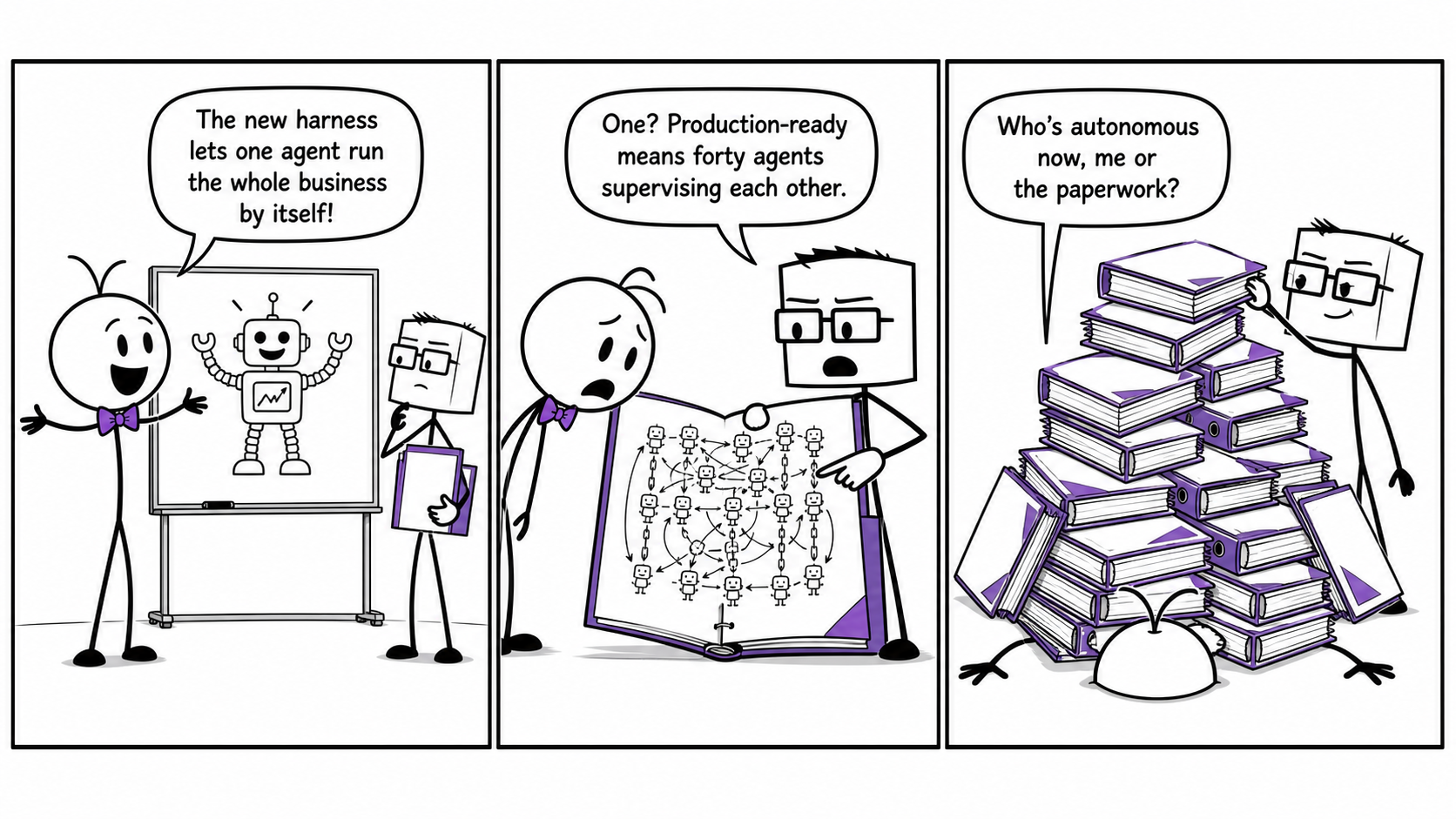
Swipe across the comic, or tap it to open full size.
Swipe across the comic, or tap it to open full size.
What would you hand to an agent first?
We want your read on this. Are you seeing autonomous agents creep into your tools or your suppliers' pitches yet? Reply to this email and tell us where you would trust an agent and where you absolutely would not. Your replies shape what we dig into next.
Both signals point the same way: Microsoft is talking louder about agents that act and agents built for real use. That is direction, not a promise of results. Treat vendor language as a starting question, not an answer. Test small, ask hard questions of suppliers, and let evidence, not marketing, set your pace.
Make the next improvement count.
Talk to Valdris about the systems and automations holding your business back.
Start a conversation