
Cheaper intelligence. Better judgement.
AI is becoming cheaper and more capable. The advantage now comes from the workflow around it.
 Brendan Tack·
·
5 min read
Brendan Tack·
·
5 min read
AI capability is becoming less scarce. Reliable implementation is not.
OpenAI is pushing more intelligence per dollar while real-time agents are moving into everyday customer service. That makes experimentation easier, but it also raises the value of workflow design: clear permissions, human review, measurable outcomes and an audit trail.
Two developments worth your attention
The signal is not “buy more AI.” It is “revisit the economics of one bounded workflow.”
GPT-5.6 pushes intelligence per dollar
OpenAI says GPT-5.6 improves efficiency across models, inference and agentic workflows. For small teams, the useful question is whether a previously uneconomic process now fits a sensible budget.
Read the source →A retail agent serves shoppers around the clock
Avatarin used GPT-Realtime for multilingual support at Yamada Denki. OpenAI reports 30,000 users in two weeks and 92% positive survey responses.
Read the source →24/7 support without pretending the system is magic
The interesting part of Avatarin’s retail deployment is not that an AI talked to customers. It is that the workflow had a defined audience, channel and job: multilingual support for Yamada Denki shoppers. That bounded scope made adoption and satisfaction measurable.
Steal this: define the job, the users and the success measure before choosing the model.
Re-price one repetitive workflow
Choose one recurring task that was too costly or unreliable to automate six months ago. Use real volumes rather than a vague “AI could help” idea.
2. Mark the exact decision the AI may make—and the one it may not.
3. Estimate model cost, review time and failure handling together.
4. Run ten historical examples before connecting live systems.
Measure: cost per completed case, review rate and correction rate—not the number of AI outputs.
The bounded customer-service agent
A dependable agent is a small operating system, not a chat box with permission to improvise.
Exception path: stop cleanly when identity, data or policy confidence is insufficient.
When building gets faster, judgement becomes the work.
AI can compress the distance between an idea and working software. That does not remove the bottleneck; it moves it. Choosing the right problem, knowing what to leave out and recognising when something feels wrong become more valuable—not less.
— Brendan
Cheaper intelligence still needs a checkpoint
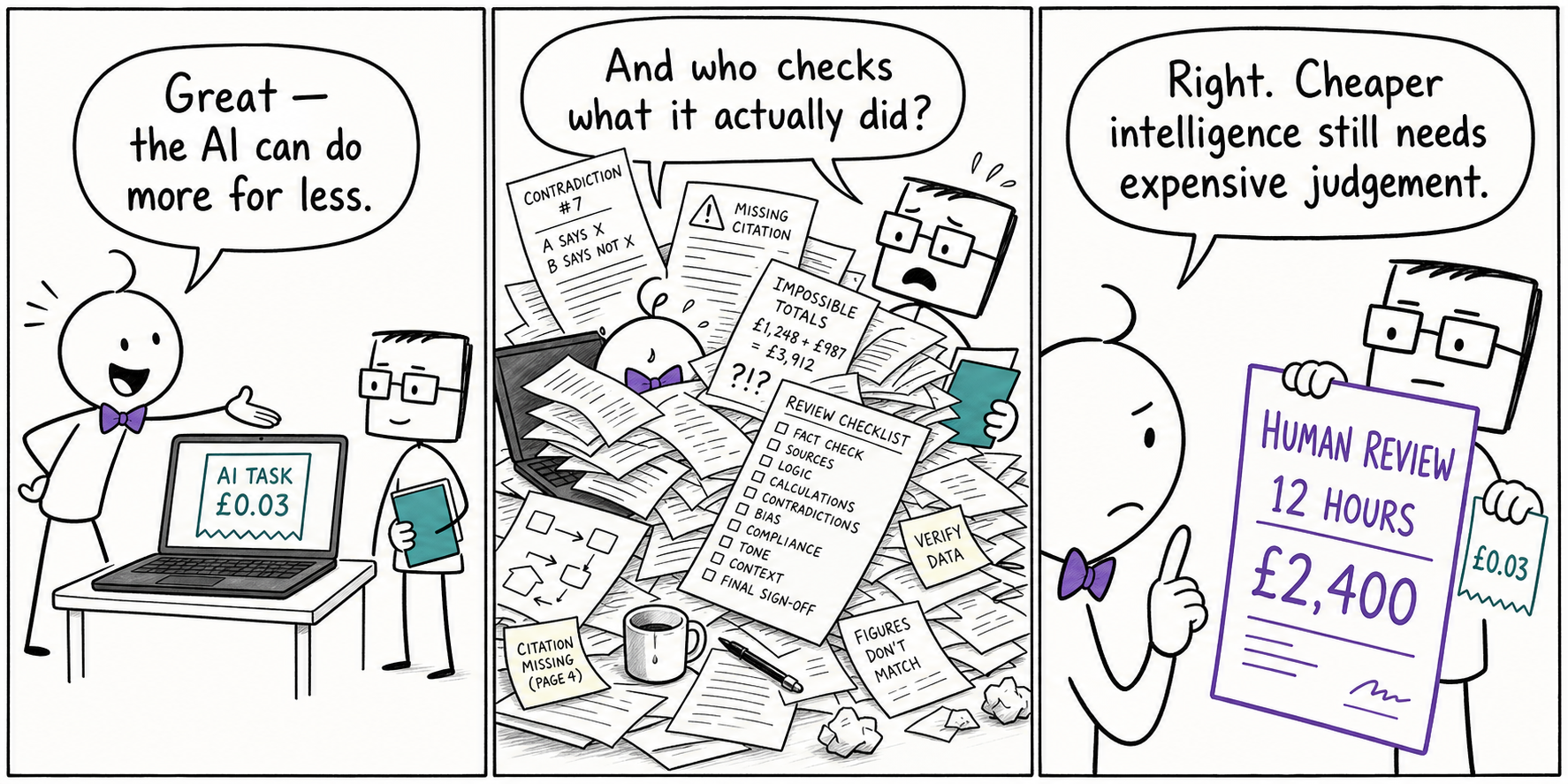
Swipe across the comic, or tap it to open full size.
Make the next improvement count.
Talk to Valdris about the systems and automations holding your business back.
Start a conversation