

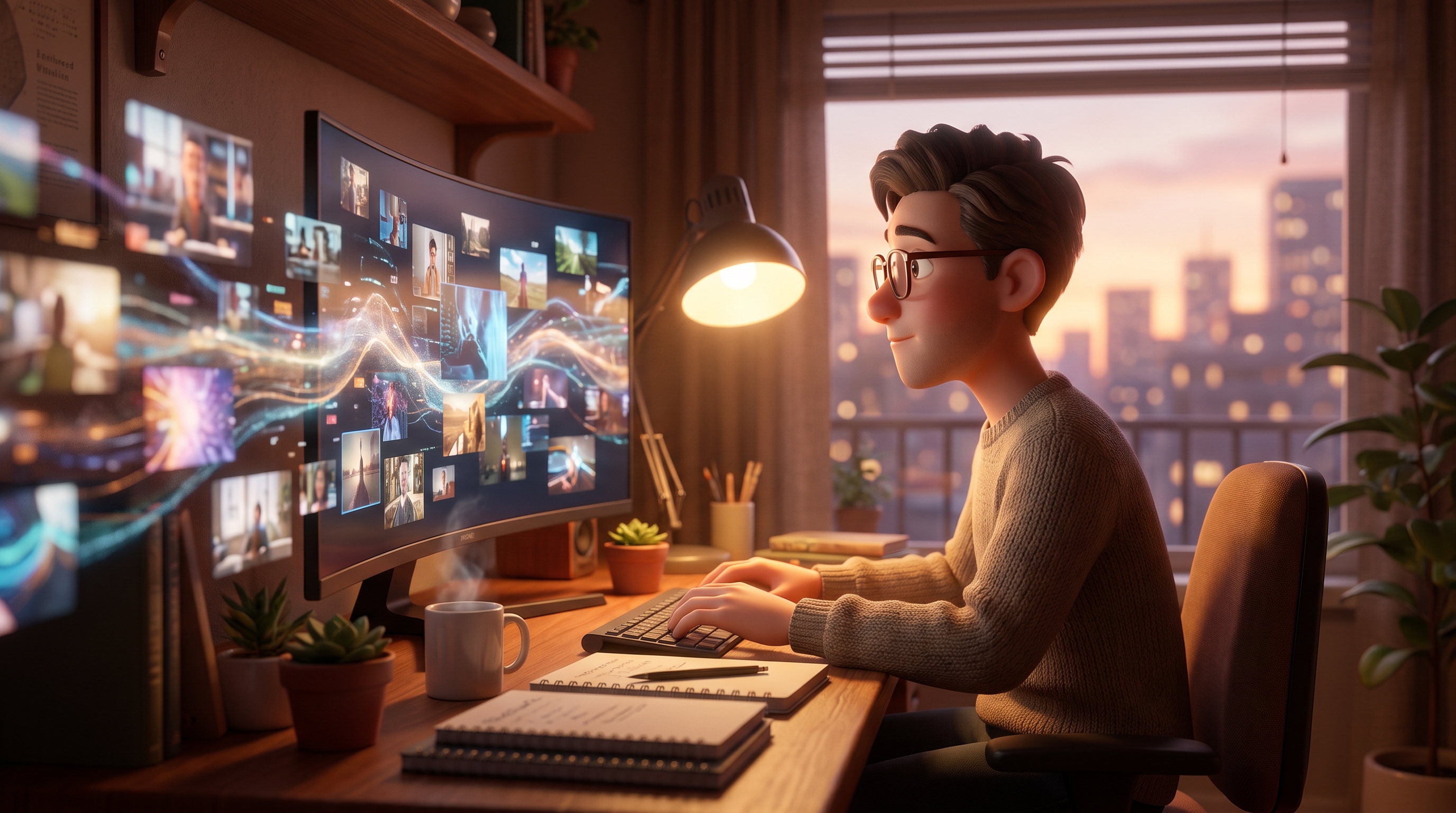
For most of its history, video has been finished before we see it. Even livestreams are finished in one important sense: the cameras capture whatever is already happening. The viewer can comment, vote or change channels, but the pictures themselves are not being invented in response.
Real-time generative video changes that relationship. The screen can begin to behave less like a recording and more like a living system: it can listen, react, remember a choice and generate what happens next.
That does not mean a flawless, 24-hour AI drama is ready today. Google DeepMind says Genie 3 can produce navigable 720p worlds at 24 frames per second, but currently supports only a few minutes of continuous interaction. Odyssey says its current simulations can run for minutes, while explicitly setting out an ambition to reach hours, days and eventually years.[1][3] The gap between those two sentences is the entire commercial opportunity—and most of the risk.
The first wave of AI video was about making clips. The next could be about operating worlds.
Three different changes are arriving at once
“Real-time video generation” currently describes several distinct capabilities.
Live transformation takes an existing camera or rendered feed and changes its appearance as it runs. Decart’s Mirage LSD, for example, is positioned as a prompt-controlled video-to-video system for live events, gaming, streaming, production and advertising.[2]
Interactive world models generate the next frame in response to what a person does. Odyssey now offers interactive and viewable streams through an API, while DeepMind’s Genie 3 demonstrates real-time navigation and promptable events inside generated environments.[1][3]
Generative production tools bring AI feedback onto the set. On Miramax’s Here, Metaphysic says its live system placed face replacement and de-ageing over the actors’ performances at up to 30 frames per second. The director and actors could see younger versions while they worked, rather than discovering the effect only in post-production.[6]
These are not yet the same product. But put them together with speech, narrative agents, audience data and persistent memory, and television starts to look very different.
E-learning becomes an experience, not a playlist
The strongest educational use case is not an AI presenter reading a personalised script. It is an environment in which the lesson responds to the learner.
Imagine a child entering an ancient city to investigate why its water supply is failing. They interview generated characters, inspect an aqueduct, make a repair and see the consequences. If they misunderstand pressure or gradient, the story can create a smaller experiment inside the world. If they are ready for more difficulty, the city introduces budgets, politics or a second engineering problem.
The same system could let a learner:
- shrink into the bloodstream to understand circulation;
- run a wildlife rescue while learning ecology and arithmetic;
- negotiate in another language with characters who adjust their vocabulary;
- rebuild a historical event from competing primary accounts;
- rehearse customer service, safety or leadership decisions in a responsive workplace.
A viable commercial product would be a bounded learning engine with curriculum goals, trusted source material, teacher controls and evidence of what the learner understood.
That distinction matters. A 2025 review in Frontiers in Education argues that evidence for AI delivering high-quality education at scale remains limited and warns that children’s privacy, autonomy, dignity and development need explicit protection.[7] A visually compelling adventure can still teach the wrong thing, profile a child unfairly or optimise for time-on-screen rather than learning.
A credible e-learning business would therefore keep the teacher in charge. It would generate inside approved knowledge and story boundaries, ask the learner to explain and apply ideas, provide adults with a factual session summary, and measure delayed retention rather than clicks, minutes or smiles.
Potential buyers include schools, training providers, museums, publishers and families. Revenue could come from institutional licences, family subscriptions, curriculum worlds, assessment modules and safe creator marketplaces. The smallest sensible pilot is not an open-ended virtual school. It is one five-minute adventure tied to one learning objective, tested against an ordinary lesson.
From episodes to always-on story worlds
Now take the same architecture into entertainment.
A 24-hour series probably would not resemble a conventional drama stretched until it breaks. Good stories need rhythm, consequence and endings. Instead, it could resemble a place that is always alive.
The audience enters a persistent town, spaceship, resort, courtroom or reality-show house. Characters have goals, relationships, memories and daily routines. Events continue when any one viewer leaves. Some scenes are quiet; others become major plot points. Human showrunners define the world, its tone, its non-negotiable canon and the events it is allowed to generate. AI operates the moment-to-moment performance inside those rails.
This creates several viewing modes:
- The live world: an always-on stream for committed fans.
- The episode: a human-edited daily or weekly cut that turns the best developments into a coherent story.
- The character feed: follow one participant’s perspective, diary or private subplot.
- The interactive room: viewers vote, ask questions or trigger approved events.
- The personal branch: an individual explores a non-canonical version without changing the shared show.
The live layer creates participation. The edited layer creates meaning. Without both, an endless series risks becoming expensive visual wallpaper.
A new era of reality TV—without pretending synthetic people are real
Reality television is an especially plausible bridge because it already combines continuous activity with produced episodes. Paramount describes Big Brother as running multiple live cameras throughout the day and night, while edited broadcasts turn selected moments into the official weekly narrative.[5]
A generated format could borrow that structure without copying the deception or surveillance.
Picture a fictional reality house populated by clearly labelled synthetic characters. Each has a public biography, private objectives and relationships that evolve. Viewers can watch any room, support contestants, introduce a bounded challenge or vote on which secret becomes public. Human producers can intervene, remove unsafe material and decide what counts as canon.
Unlike today’s reality cast, these characters could inhabit impossible settings: a lunar colony, a Regency estate, a fantasy tavern or a startup accelerator in 2040. The attraction would not be “Are these people real?” It would be “What happens when this social system keeps running?”
There is already a small signpost. Showrunner Studio describes AI series built around persistent sets, characters and canon; viewers can branch a world, remix it and propose new episodes while the original creator retains canonical control.[4] That is not yet a photorealistic, autonomous, 24-hour channel. It does show a business model shifting from selling a finished episode to managing an expandable story world.
This could produce a new category somewhere between reality TV, simulation games, livestreaming and fan fiction. The audience would not only watch the cast. It would become part of the format.
Interactive TV needs more than a voting button
Previous interactive television usually offered a small set of pre-recorded branches. The viewer chose A or B; the player loaded the corresponding clip. Real-time generation removes the need to film every possible branch in advance.
But unlimited choice is not automatically good television. If every viewer receives a completely different story, there is no shared cultural moment. If the audience can change anything, choices stop carrying weight. If interruptions arrive every minute, watching becomes work.
The better model is layered control:
- The writers control meaning: themes, arcs, character truths and endings worth reaching.
- The system controls continuity: state, locations, props, schedules and consequences.
- The audience controls selected pressure points: alliances, challenges, questions, routes or world events.
- The individual controls optional branches: personal exploration that does not destroy shared canon.
In other words, the product is not a prompt box attached to a television. It is an authored possibility space.
The business model moves from titles to worlds
Streaming economics are built around acquiring or producing titles, attracting subscribers and keeping them watching. Persistent generated worlds introduce different assets and revenue lines.
A studio could license a world rather than only a season. Fans might subscribe to the live channel, pay for character perspectives, buy a limited ability to influence events, create approved side stories or purchase a polished cut of a branch they helped shape. Brands could sponsor in-world locations or challenges, although generated product placement would need strict disclosure and frequency controls.
Creators could earn from the worlds, characters and rule systems that other people build upon. Showrunner already frames its product this way: published worlds can be remixed, with canonical control and potential earnings retained by the creator.[4]
The defensible asset is therefore unlikely to be raw generation quality. Models will improve and visual styles will spread. The durable value sits in licensed rights, memorable characters, trusted production rules, story memory, audience communities, moderation systems and the editorial judgement that turns thousands of generated moments into something worth following.
Film production changes before films disappear
The near-term effect on film and high-end television is more practical than replacing a set with a prompt.
Real-time look development can let a director test locations, weather, costumes and effects during rehearsal. Virtual production can become responsive instead of relying only on pre-built backgrounds. A performer might act opposite a creature or younger character while seeing a useful live approximation. Small teams could previsualise scenes, test coverage and explore alternatives before expensive shooting days.
Miramax’s Here is a useful example because the AI served a specific production decision and preserved the actors’ performances.[6] That is a more credible template than assuming a model can currently improvise a coherent feature film indefinitely.
The long-term production role may look like a live simulation department sitting beside the writers’ room and control room. It would manage character state, world rules, safety, continuity and generation cost while human directors shape tone and select what audiences see.
The rights problem becomes a runtime problem
A finished production can clear a performance for a known script, territory and period. A never-ending show may generate new dialogue, situations and marketing material every hour. Consent cannot be a one-time checkbox if the possible use is effectively unlimited.
SAG-AFTRA’s 2025 commercials terms require consent before creating a digital replica, informed consent before use, a reasonably specific description of that use, compensation, access controls and—in some circumstances—destruction of retained replicas.[8] Although a different contract would govern many film and television productions, the operating principles are relevant: consent, control, compensation and security have to be built into the system.
A responsible always-on production would need machine-readable rights attached to every voice, face, character, location and piece of music. The runtime must know what it may generate, for which audience, for how long and under whose approval. When rights expire, the system must stop—not improvise around the contract.
The same applies to children’s learning: no hidden emotional profiling, no manipulative engagement loops, no open contact with strangers and no automatic publication of a child’s generated film.
What has to improve before the channel can stay alive
Today’s demonstrations are enough to test short experiences, not enough to hand over a television network.
The remaining problems are not just sharper pixels:
- Long-horizon memory: characters must remember promises, injuries, relationships and events over months.
- Narrative control: surprise must stay inside a coherent dramatic shape.
- Multi-character performance: several independent characters must interact without collapsing into repetition.
- Safety at frame speed: moderation has to happen before harmful images or dialogue reach the stream.
- Cost and reliability: a 24-hour channel cannot fail every time a GPU disappears or an output needs regenerating.
- Editorial provenance: producers need a record of why a scene happened, what inputs shaped it and who approved it.
- Rights enforcement: identity, music, brands and story assets need executable permissions.
- Shared canon: millions of viewers need a common world even when personal branches exist.
DeepMind explicitly lists limited action space, multi-agent interaction and duration as current constraints for Genie 3.[3] The honest position is that never-ending television is a product direction, not a solved format.
Start with a living hour, not an infinite series
The sensible pilot is a one-hour world with hard boundaries.
Give it three or four original characters, one location, a clear dramatic objective and a small menu of audience interventions. Let the system run live. Then have human editors produce a ten-minute episode from the session. Measure where viewers stayed, whether choices felt meaningful, whether continuity held, how often producers intervened, what generation cost per watched minute, and whether anyone returned for the next session.
For education, use the same discipline: one learning objective, one short adventure, teacher review and a retention test later.
If that works, extend the world to an evening, then a weekend, then a season. “Never-ending” should be the result of a system earning trust, not the launch slogan.
Television may become somewhere we visit
The most important shift is not infinite content. We already have more video than anyone can watch.
It is the possibility that a television programme becomes a place with memory: always available, occasionally surprising, shared with an audience and responsive without surrendering its identity. Reality formats may become simulations with editorial control. Drama may gain live side worlds between canonical episodes. Education may turn abstract concepts into adventures that respond to the learner.
The winners will not be the companies that generate the most footage. They will be the ones that know what must remain human: authorship, consent, care, judgement and the decision that a story has become worth telling.
Sources
[1] https://odyssey.ml/the-gpt-2-moment-for-world-models — The GPT-2 Moment for World Models Is Here [2] https://decart.ai/mirage-lsd — Mirage LSD — Real-time Video Restyling AI [3] https://deepmind.google/blog/genie-3-a-new-frontier-for-world-models — Genie 3: A new frontier for world models [4] https://www.showrunnerstudio.com — Showrunner Studio [5] https://www.paramountplus.com/sneak-peak/big-brother-live-feeds — How To Watch Big Brother Live Feeds [6] https://metaphysic.ai/post/ai-hollywood-miramax-here — Metaphysic — Miramax Here [7] https://www.frontiersin.org/journals/education/articles/10.3389/feduc.2025.1656736/full — AI, education, and children’s rights [8] https://www.sagaftra.org/contracts-industry-resources/commercials/2025-commercials-contracts — 2025 SAG-AFTRA Commercials Contracts