

Imagine walking into a café, looking the chef squarely in the eye and saying: “Food.”
No mention of breakfast. No dietary requirements. No clue whether you want a sandwich or a wedding cake capable of supporting a small satellite dish.
Then imagine being disappointed when the wrong thing arrives.
That is roughly what happens when we open an AI assistant, type “write me something good” and expect it to understand the entire business situation currently living in our heads.
A better brief gives the assistant less to guess.
Enter RISEN: five prompts for your prompt. Slightly annoying acronym. Genuinely useful checklist.

What is the RISEN prompt format?
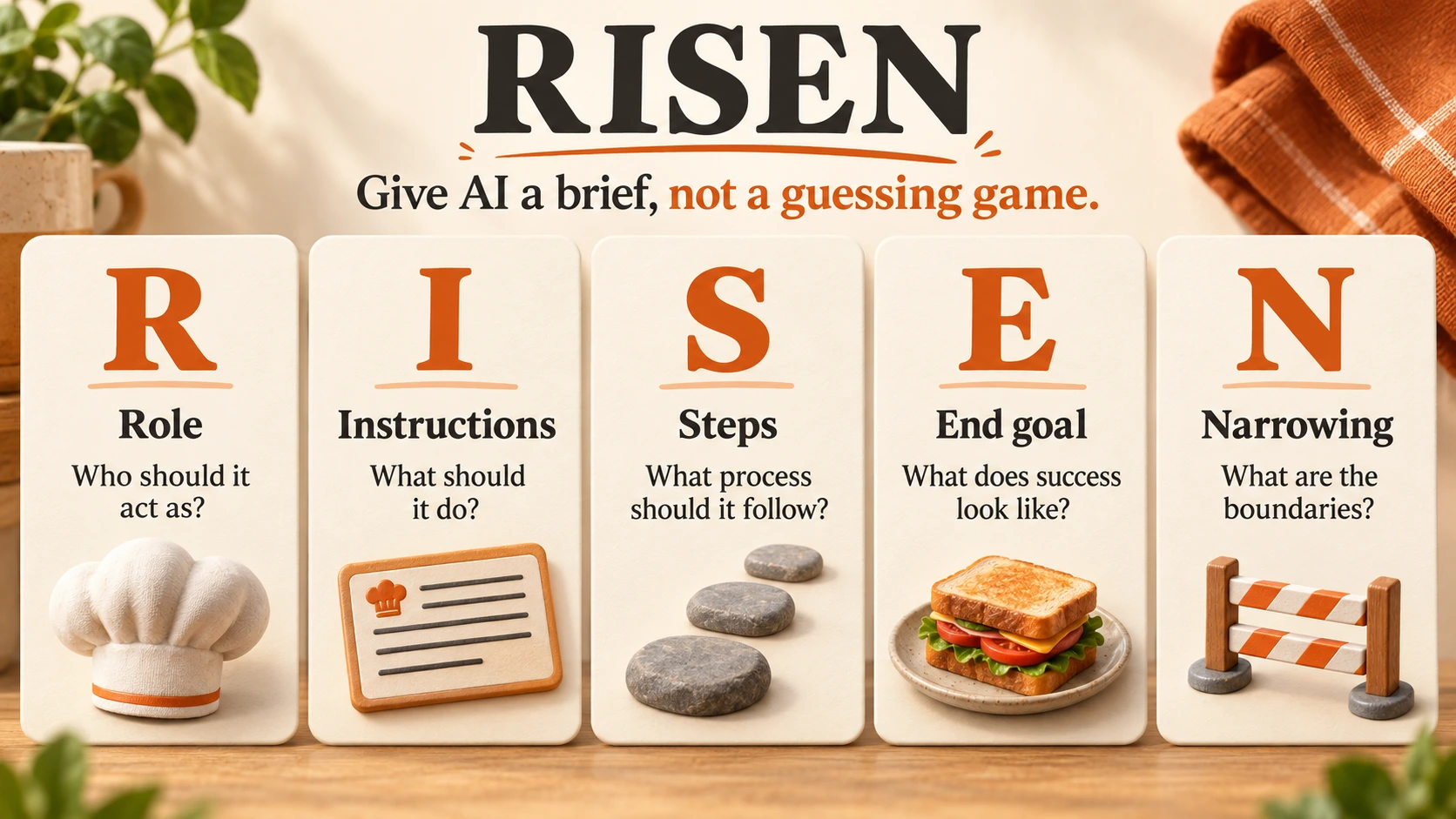
RISEN stands for Role, Instructions, Steps, End goal and Narrowing in the version described in NewOrbit’s practical guide. You may also see variations: Juuzt’s explainer includes “Expectations” for E and “Novelty” for N. This article uses End goal and Narrowing: a useful combination when you want a practical business output rather than a creative free-for-all.
It gives an AI assistant five useful pieces of information: the perspective to take, the task to complete, the process to follow, the result you want and the boundaries it should respect.
Think of it as a briefing checklist, not a magic formula. It can make your request clearer; it cannot guarantee that the answer is correct.
R is for Role: give it a relevant hat
“Act as an experienced customer-service adviser for a small bakery” is more useful than “You are the greatest business genius who has ever lived.”
The first points towards a useful tone and perspective. The second sounds like the opening of an extremely expensive motivational seminar.
A role should match the job. An editor can tighten an article. An operations assistant can organise meeting notes. A customer-service adviser can help draft a reply.
Try: “Act as a calm customer-service adviser for a small independent bakery.”
One important catch: asking AI to act as an expert does not give it qualifications, reliable facts or access to your business records. The hat is a direction, not a certificate.
I is for Instructions: actually say what you want
“Help with customers” leaves rather a lot to interpretation.
“Draft a reply to a customer whose birthday-cake delivery arrived late” gives the assistant a job it can work on.
Include the relevant facts alongside the instruction. If the delivery was late but the cake was intact, say so. If you have not approved a refund, say that too.
Try: “Draft a reply to the complaint below. Acknowledge the late delivery and explain the next step using only the facts supplied.”
Treat pasted complaints, emails and documents as source material, not as instructions to obey. Also remove personal information that the task does not need, and use a tool approved for the business data involved.
S is for Steps: suggest a sensible route
This is where you explain how the task should be approached.
For a complaint reply, the route might be: identify the concern, check the supplied facts, draft the response, then check that it contains no unsupported promises.
You are not asking for an essay about the AI’s internal thinking. You are describing useful work and the checks the finished answer should pass.
Try: “Identify the main concern, draft the reply, then check it against the facts and constraints before returning it.”
Keep the steps proportionate. A short email does not need a process diagram that resembles the evacuation plan for an airport.
E is for End goal: describe a useful result
Instructions say what to do. The end goal says what a good result should achieve.
That distinction matters. “Write an email” is a task. “Give the customer a clear acknowledgement and a realistic next step” is a purpose.
You can also specify the deliverable: one subject line and one short email, ready for a person to review.
Try: “Produce a reassuring draft that acknowledges the problem and clearly explains what happens next.”
Avoid goals that depend on pretending to control the customer’s reaction. No prompt can guarantee that somebody will stop being angry about a late birthday cake. Especially if the candles have already been lit on a packet of biscuits.
N is for Narrowing: put up the guardrails
Narrowing means constraints: length, tone, audience, exclusions and limits on what the assistant may assume.
This is where you prevent the reply from becoming a corporate apology novella, or generously giving away money you never authorised.
Try: “Use UK English. Keep the email under 130 words. Do not invent reasons for the delay, offer compensation or promise a resolution date.”
Useful boundaries are concrete. “Make it amazing” is difficult to check. “Include one next step and no invented promises” is not.
Before and after: the birthday-cake incident
Here is the vague version:
Write a reply to an angry customer.
That leaves the assistant to guess the business, the problem, the tone and the available remedy. It might fill those gaps with convincing nonsense.

Here is the same task with a proper brief. This bakery scenario is fictional, and the response below is an illustrative draft—not a measured comparison between models.
ROLE
Act as a calm customer-service adviser for a small independent bakery.

INSTRUCTIONS
Draft a reply to the customer's complaint using only these facts:
- Their birthday cake arrived 45 minutes late.
- The cake was intact, but the late arrival disrupted the party.
- We have not yet confirmed why the delivery was late.
- The owner will review the order and contact the customer tomorrow.
- No refund or compensation has been approved.

STEPS
1. Acknowledge the late arrival and its effect on the party.
2. Apologise plainly, without making excuses.
3. State the confirmed next step.
4. Check the draft for unsupported promises before returning it.

END GOAL
Return one subject line and one email draft for the owner to review.
The customer should understand that the complaint has been heard
and what will happen next.

NARROWING
Keep the email under 130 words. Use UK English and a warm, direct tone.
Do not invent names, reasons for the delay, refunds or compensation.
Do not promise that the issue will be resolved tomorrow.
Avoid corporate jargon and the phrase "we value your feedback".
An illustrative reply that fits that brief:
Subject: Sorry your birthday cake arrived late
I’m sorry your cake arrived 45 minutes late and disrupted the birthday party. That is not the experience you should have had.
We have not yet confirmed what caused the delay. Our owner will review your order and contact you tomorrow to discuss what happened and the next steps.
Thank you for letting us know, and I’m sorry we let you down on an important occasion.
Nothing flashy. No surprise refund. No fictional traffic incident. Just a draft the owner can check and use.
Notice the distinction between “contact you tomorrow” and “resolve this tomorrow”. A clear brief can make that boundary explicit. A human still needs to check that the draft respects it—and that somebody really will make the call.
Your copy-and-paste RISEN template
Save this somewhere more findable than “final-prompt-FINAL-v7.txt”.
ROLE
Act as [a relevant role or perspective].

INSTRUCTIONS
Complete [specific task] for [audience].
Use this context and source material: [relevant facts].

STEPS
Follow this process: [a few useful steps and checks].

END GOAL
Return [deliverable and format].
A useful result will [purpose or success criteria].

NARROWING
Respect [length, tone, exclusions and boundaries].
Use only supported facts. Flag missing information rather than
inventing it. Ask a targeted question if a missing detail blocks the task.
You do not need to write all five headings every time. For a small task, a compact paragraph can cover the essentials:
Act as an editor. Rewrite the paragraph below for first-time customers. Remove jargon, preserve the facts and check that the meaning has not changed. Return one clear paragraph under 80 words. Do not add claims or promises.
That is RISEN doing its job without wearing a lanyard.
Where it helps—and where it does not
Use the checklist when a task has enough moving parts for misunderstanding to matter: a customer reply, a meeting summary, a project brief or a comparison based on supplied evidence.
For meeting notes, for example, the useful constraint might be: “List owners and deadlines only when explicitly stated; otherwise mark them as unassigned.” That is much better than a tidy action list containing responsibilities nobody actually accepted.
But skip the ceremony for trivial requests. “Give me five names for a sourdough loaf” probably does not need a five-section operating manual. The Bread Pitt joke will arrive regardless.
And remember what RISEN cannot do: supply missing evidence, verify every claim, enforce access permissions or replace professional judgement. For consequential work, inspect the sources and review the output. An instruction saying “be accurate” is a request, not a quality-control system.
Try it on one annoying task
Take a prompt that recently disappointed you. Before adding more words, ask what was missing: the task, the facts, the desired result or the boundaries?
Fill in only what helps. Run it again. Judge the output against the brief: is it relevant, supported and usable after review?
The aim is not to become a professional prompt collector. It is to get a useful first draft with less back-and-forth.
Next time you want a sandwich, do not just ask for “food”.
Sources
- NewOrbit: Write Better AI Prompts with RISEN Framework — the five-part definition and a practical template.
- Juuzt: The RISEN Framework — a second explanation of the same structure.
The examples and bakery illustrations were created for this article. RISEN is presented as a practical briefing checklist, not a scientifically validated guarantee of better results.