

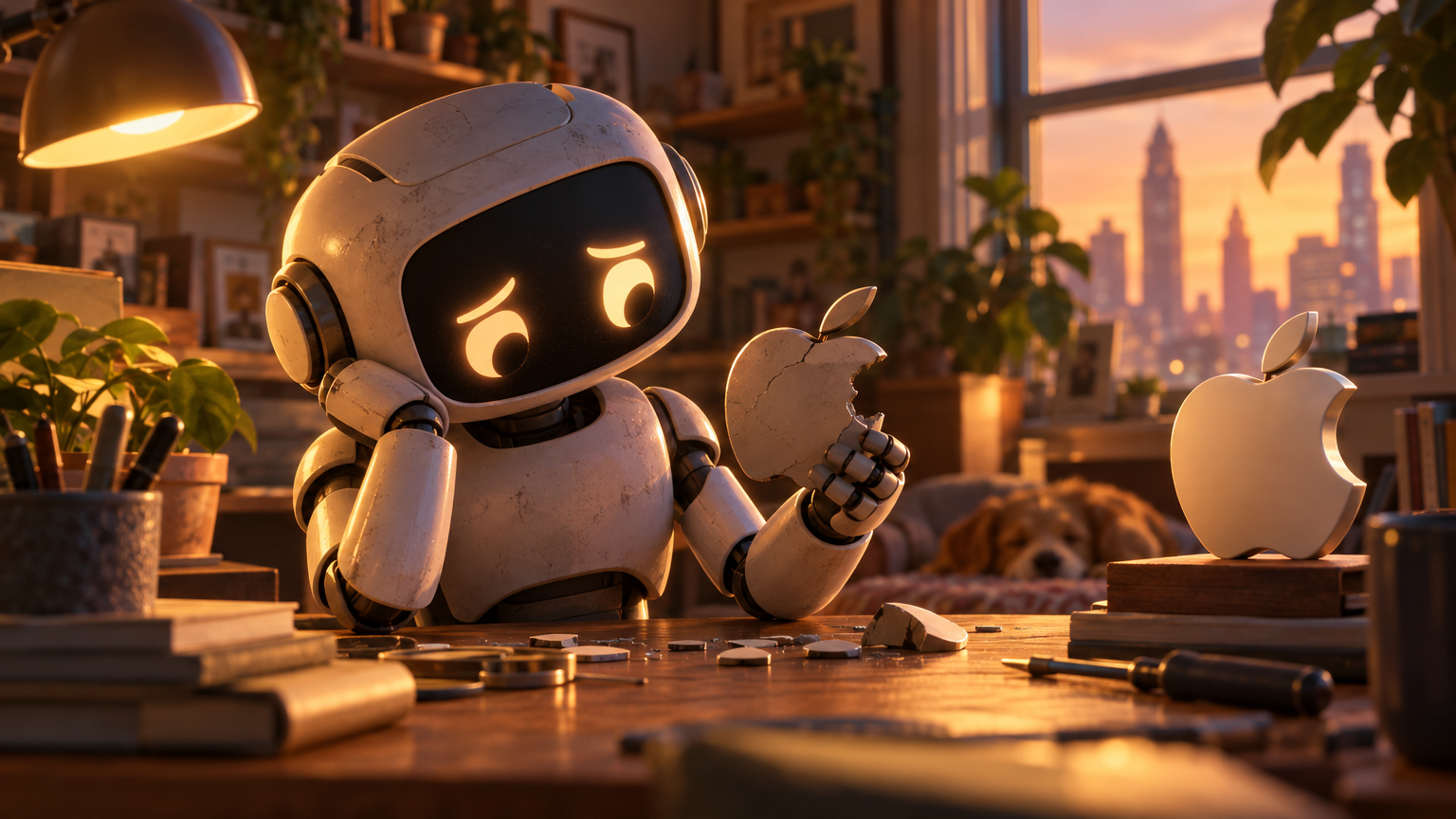
Steve Jobs stood on stage in 2007 and asked: “Who wants a stylus?”
His answer was blunt. You had to take it out, put it away and avoid losing it. We already had fingers. Why make using a phone more complicated?
Now Apple has announced Apple Pencil support for the iPhone Duo. It has also announced a touchscreen MacBook Pro, despite Jobs having described vertical touchscreens as “ergonomically terrible”.
I understand why people look at those decisions and wonder whether Apple has forgotten what it stands for. I have the same question.
But the argument deserves more than a compilation of old keynote clips. Jobs made product decisions for particular problems, at particular moments. Apple should be allowed to change its mind. What it needs to explain is why the new decision makes the product better.
Looking at his philosophy alongside Apple's latest announcements, I think the strongest criticism concerns the extra complexity Apple is asking customers to manage.
What Jobs was trying to protect
The stylus line came from the original iPhone launch on 9 January 2007, rather than Apple's beginnings. Jobs was explaining how someone would operate a phone whose front was largely a screen. His alternative to fixed controls and a separate pointing device was direct interaction with your fingers. [1]
Behind the theatre was a practical design choice: remove a thing the customer otherwise had to carry and think about.
A decade earlier, at Apple's 1997 developer conference, Jobs had put his broader approach plainly:
“You've got to start with the customer experience and work backwards to the technology.” [2]
That puts a burden on the company making the product. Having the technology to add a feature is insufficient. There has to be a convincing reason for a person to use it.
His approach to focus was equally demanding. In remarks preserved by the Steve Jobs Archive, he described reducing Apple's computer strategy to consumer and professional products, each with desktop and portable versions. Concentrating on four products let Apple put its best people on each and improve them more quickly. [3]
That was a recovery strategy for the Apple of the time, not a permanent rule that the company could only ever sell four things. But the underlying discipline matters: a business cannot treat every plausible addition as equally worthwhile.
Taken together, these ideas give us a useful standard. Make the everyday experience easier. Give each product a clear purpose. Be willing to leave things out.
The Pencil on the Duo is a reversal, with an important qualification
Apple's September 2026 announcement describes the iPhone Duo as a foldable phone with a larger inner display. It says support for Apple Pencil with USB-C will let people take notes, sketch and mark up documents on either display. [4]
Those are specific uses. Writing a note or drawing a precise line is different from opening an app or answering a call. An optional drawing tool does not automatically undermine a phone designed around fingers.
That is the strongest defence of Apple's decision. The Pencil can serve a different job from the stylus Jobs was rejecting as a general way of operating a phone.
Still, the details deserve scrutiny.
In its 23 October hands-on report, MacRumors said the Duo supported the USB-C Pencil, rather than the first-generation, second-generation or Pro models. It described pairing through a USB-C cable and magnetic storage at the hinge without magnetic charging. At the time of that report, support was in the iOS 27.2 beta. That is a dated observation, not a claim about the software's release status when you read this. [5]
This is where I find the criticism more persuasive. A customer who already owns an Apple Pencil may need to establish whether it is the right Pencil, how it pairs and how to charge it.
There may be sound engineering reasons for those choices. They still become things the customer has to understand.
Jobs objected to the inconvenience of carrying and managing a separate tool. That concern has not disappeared because the tool now has an Apple logo. Apple needs to make the benefit of carrying it worth the inconvenience.
For someone who regularly annotates documents while travelling, it could be. For someone who wants an uncomplicated phone, it may be another accessory they can safely ignore. The everyday phone experience should remain complete without it.
The touchscreen MacBook is the more direct contradiction
Jobs's argument against touchscreen laptops was about the human body.
At the October 2010 Mac event, he said Apple had tested the idea and found that reaching towards a vertical surface caused fatigue. His objection was particularly memorable because he distinguished an impressive demonstration from prolonged use. Apple's preferred answer was to put multitouch on the horizontal trackpad. [6]
On 28 October 2026, Apple announced the MacBook Pro with PROLED XDR Display and touch input, with availability scheduled to begin on 6 November. Its announcement describes swiping through webpages, pinching photos, manipulating windows and interacting directly with creative content. [7]
That is a real change in Apple's public position. It should not be brushed aside as though Jobs had merely disliked an old display technology.
A better screen does not, by itself, solve arm fatigue.
There is a reasonable counterargument: a brief tap or pinch could be useful even if reaching towards the screen all afternoon would be uncomfortable. Optional touch alongside a keyboard and trackpad is a different proposition from making touch the main input method.
But that is a hypothesis to test. It does not establish that this particular MacBook gets the balance right.
I have not tested the announced machine. Apple's press release establishes what the company is offering and how it describes the benefits; it is not independent evidence of comfort over a working day.
I would want to see someone use it for ordinary work. Does touch save effort often enough to become useful? Do they keep switching awkwardly between input methods? Can they ignore touch without losing access to important functions?
Those are better questions than whether Apple can make an appealing launch video.
Apple has become harder to explain in one sentence
The historical contrast is striking. Jobs's iPhone presentation explained why customers could stop carrying a separate pointing device. Today's Duo introduces a further option, with its own compatibility and setup considerations.
His Mac argument drew a clear boundary between a screen you looked at and a horizontal surface you touched. Today's MacBook adds another way to interact with the same content.
Options can help. A person who draws, edits music or marks up plans may reasonably want more than the simplest possible interface. Treating all complexity as a design failure would exclude people with demanding work to do.
My concern is where that complexity lands.
Apple can do difficult work inside its products so that users have less to manage. Or it can expose more choices, modes and exceptions and expect people to work out what suits them. These announcements give us concrete reasons to examine that balance, although they do not prove that every part of Apple has moved in the same direction.
The Pencil compatibility question is a small example. It is also the kind of detail that affects whether an ecosystem feels thoughtfully joined up.
There is evidence of continuity, too
Any claim that Apple abandoned Jobs's philosophy after his death has to account for Apple silicon.
Apple introduced its first M1 Macs in November 2020, combining its own Mac chip with an operating system designed to take advantage of it. The announced benefits included performance and battery life, with a fanless MacBook Air. [8]
The significance here goes beyond benchmark claims. Controlling more of the hardware and software together gave Apple a way to change the experience of using a laptop. That fits comfortably with the customer-led, integrated approach associated with Jobs.
It also shows why judging Apple by whether it preserves every old product decision is inadequate. The company can change the underlying technology substantially while retaining a recognisable philosophy.
Equally, a feature that looks like a contradiction can earn its place if it solves a real problem well. Keeping a bad restriction forever would be a peculiar way of honouring a product designer.
Apple owes customers a clearer explanation
My view is that Apple has moved away from some of Jobs's clearest product boundaries. The touchscreen MacBook makes that explicit. The Pencil-equipped Duo makes the old stylus argument newly relevant, even though optional handwriting is different from requiring a stylus to operate a phone.
Neither decision, by itself, proves Apple has lost its identity. Both deserve a higher standard of explanation than “now you can do more”.
For the Duo, Apple should make the value of the Pencil clear and the compatibility, pairing and charging experience easy to understand. For the MacBook, it should demonstrate useful touch interactions in sustained work, while preserving a complete keyboard-and-trackpad experience.
That is what I would judge these products on. Jobs's old objections remain useful questions. Apple needs to answer them through the experience of using the products.
Sources and research notes
Researched on 29 October 2026. This is product analysis, not a hands-on review. Announced capabilities are separated from independent testing, and the dated beta report should be rechecked before publication.
- Original iPhone launch, 9 January 2007: keynote transcript. Third-party transcript of Jobs's remarks; source of the stylus quotation and its context.
- Daring Fireball: Working Backwards to the Technology. Quotes and links video of Jobs's 1997 WWDC discussion about customer experience and focus.
- Steve Jobs Archive: Make Something Wonderful. Jobs's collected words, including his explanation of the four-product computer strategy. The archive notes that material is edited and excerpted.
- Apple unveils iPhone Duo, 9 September 2026. Primary source for the foldable design and announced USB-C Apple Pencil use cases.
- MacRumors: Using an Apple Pencil With the iPhone Duo, 23 October 2026. Hands-on reporting on compatibility, pairing, charging and the beta status at the time of testing.
- Business Insider: Steve Jobs on touchscreen laptops, 20 October 2010. Contemporary report reproducing his remarks about vertical touch and fatigue.
- Apple announces MacBook Pro with PROLED XDR Display and touch, 28 October 2026. Primary announcement; availability scheduled for 6 November, not evidence of long-term ergonomics.
- Apple introduces the first M1 Macs, 10 November 2020. Primary source for the integrated chip/software approach and announced product benefits.