


A financial research task often starts with a queue of small jobs: find the right filing, check the reporting period, copy figures into a model, explain the assumptions and put the result into the firm’s template. Each handoff creates another opportunity for an old number or an unsupported claim to reach a client.
OpenAI’s new ChatGPT for Financial Services, announced on 10 September 2026, brings financial data, analysis and document creation into one managed workspace. For the right firm, it could reduce that preparation work.
At Valdris, we would start with a narrower question: which part of your research or reporting process can we improve while keeping your team in control of the sources, calculations and final decision?
What OpenAI has launched
ChatGPT for Financial Services is a separate ChatGPT plan built on ChatGPT Enterprise. Its initial focus is investment banking and equity research, shaped by design partnerships with Morgan Stanley and Evercore. It combines GPT-6 Astra with financial datasets, source citations and the ability to produce editable models, research notes and presentation materials. OpenAI’s announcement describes the product and its starting scope.
An administrator can publish Excel, Word and PowerPoint templates so the team produces work in the firm’s format. Users can examine supporting passages and tables behind figures, rather than receiving a polished answer with no visible trail.
Access is through OpenAI Sales or an existing account team. Eligibility depends on the organisation’s size and type and on data-provider restrictions. The plan applies to the whole workspace: standard Enterprise and Financial Services seats cannot be mixed in the same workspace. This is an important procurement detail, particularly for a smaller firm. See the official help guide.
It is also a different product from the new Agents API. Buying this workspace does not, by itself, establish an API entitlement to its included financial datasets or permission to export them into another system.
“Included data” needs a closer look
There are three different routes to financial information: selected datasets included in the plan, sources accessed through an existing provider subscription, and approved connections to other business systems.
The included list covers sources such as company filings, Quartr, Daloopa, Fiscal.ai, PitchBook Essentials and Crunchbase. That does not mean every customer gets the full commercial product from every provider.
Several limits affect whether a proposed integration is useful:
- Daloopa’s included data has a 24-hour delay and a limit of 3,000 datapoints per user per month.
- PitchBook Essentials provides selected company profiles and financing information, rather than an unrestricted PitchBook subscription.
- Nasdaq data supplied through FMP is delayed by at least 15 minutes.
- The included Reuters news access has a US restriction. The terms limit it to professional users employed by eligible financial firms’ US-domiciled or US-incorporated entities. A UK team should not assume it has access.
OpenAI also describes work on shared sign-in and entitlement connections with additional providers. We would check which connections are available to your actual workspace before including them in a project scope.
These details change the buying decision. Delayed data can be useful for research preparation; it is a poor basis for assuming a real-time trading workflow.
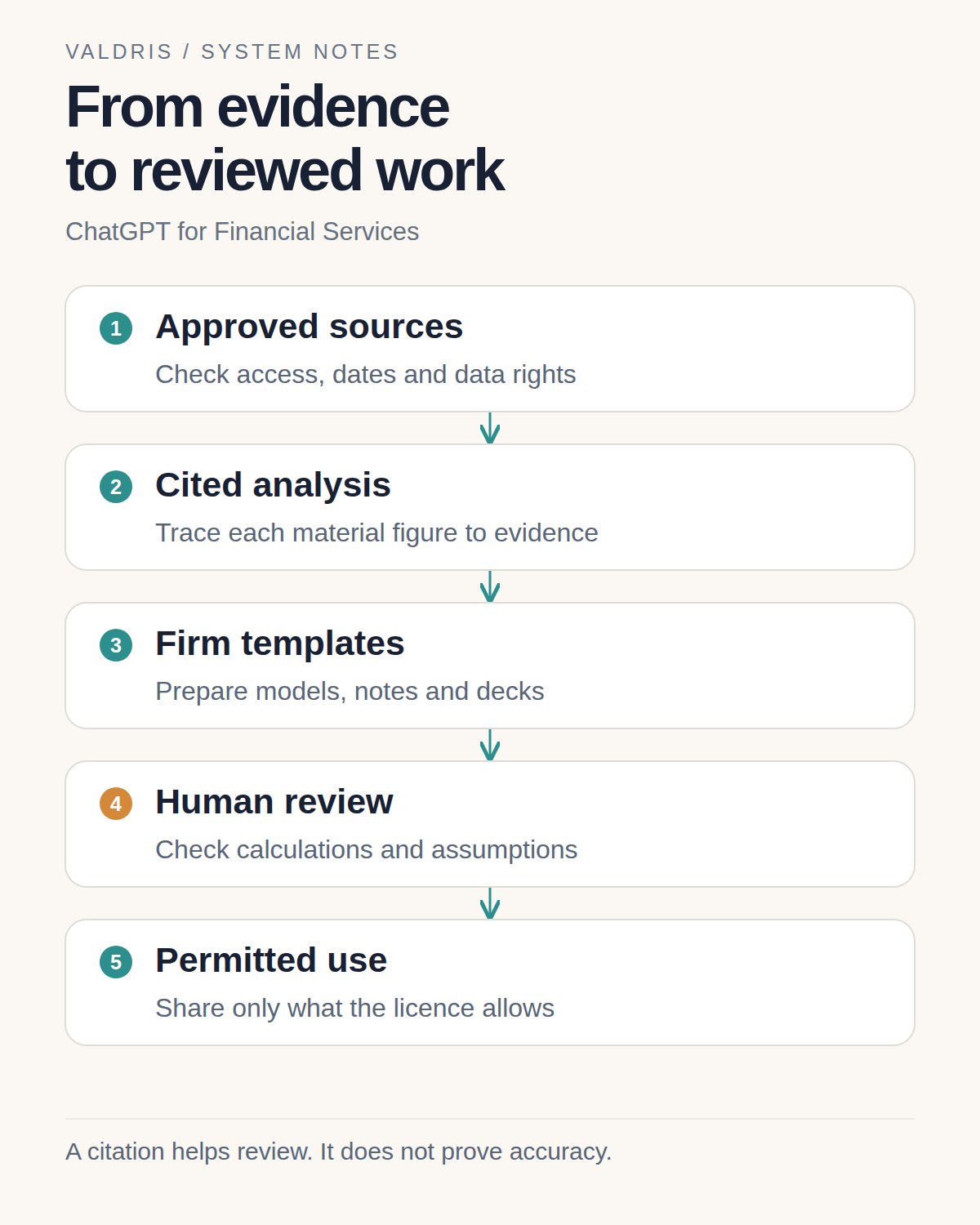
Source access, evidence checks and sharing rights are separate parts of the workflow.
Three integrations we would assess first
These are proposed services we would scope and test with a client. They are not claims that Valdris has already deployed this new product or measured savings from it.
1. A source-backed company research pack
For an eligible corporate-finance or research team, a bounded first workflow could gather an approved set of company information, compare reporting periods, identify missing evidence and create a draft research note in the firm’s Word template.
The deliverable should show the source, date, units and reporting period for every material figure. If the data conflicts or a value is missing, the draft should flag it rather than silently choose an answer.
A named analyst then checks the claims and calculations. Distribution happens only after a separate review of the source licences and the firm’s approval policy. We would begin with internal research and a few public or appropriately licensed sources, not confidential deal information.
Measure whether the complete process, including review and corrections, takes less effort than the current method. A fast first draft that takes longer to repair has not improved the workflow.
2. Model-refresh preparation with an exception report
A second useful job is preparing an update to an existing financial model. The team specifies the approved source, period, units and target fields; the AI gathers the supporting information and proposes changes.
The first pilot should generate a separate comparison file, not overwrite the master workbook. An exception report can highlight a changed reporting period, a currency mismatch, a missing note or a value that does not reconcile.
We would use deterministic spreadsheet checks for totals and relationships, alongside human review of assumptions. The model owner remains responsible for accepting the changes. Source-data rights must permit the intended download, storage and use in the workbook.
The product’s firm-template capability can help with presentation. It does not prove that formulas, forecasts or accounting interpretations are correct.
3. A controlled route from reviewed analysis to client materials
Many firms already have good analysis but lose time converting it into the right report, deck or briefing. Configured Word and PowerPoint templates offer a practical starting point.
We would define the sections, house style, mandatory caveats and evidence requirements, then generate a draft from approved analysis. The reviewer should see both the material and the supporting sources.
Client delivery is a separate gate. An export button does not grant redistribution rights. Before any deck leaves the firm, the workflow must check what each source permits, whether the information is confidential and who can authorize release.
This is a process-design and governance job as much as an AI integration.
A CRM connection can be the wrong recommendation
OpenAI’s Financial Services Terms explicitly prohibit inputting PitchBook data into a CRM or other database. They also restrict substantial raw-data exports and certain other uses.
That means “enrich your CRM with all the included company data” would be an irresponsible blanket recommendation. Technical access and permitted use are different questions.
Other partners impose their own restrictions on storage, redistribution and derived information. Passing data through an AI-generated summary does not automatically remove those obligations. The same applies to a client-facing report that combines several sources.
Where CRM enrichment is genuinely useful, we would identify a separately permitted source and licensed integration route. Where the rights are unclear, the integration stops until the provider or your legal team confirms them.
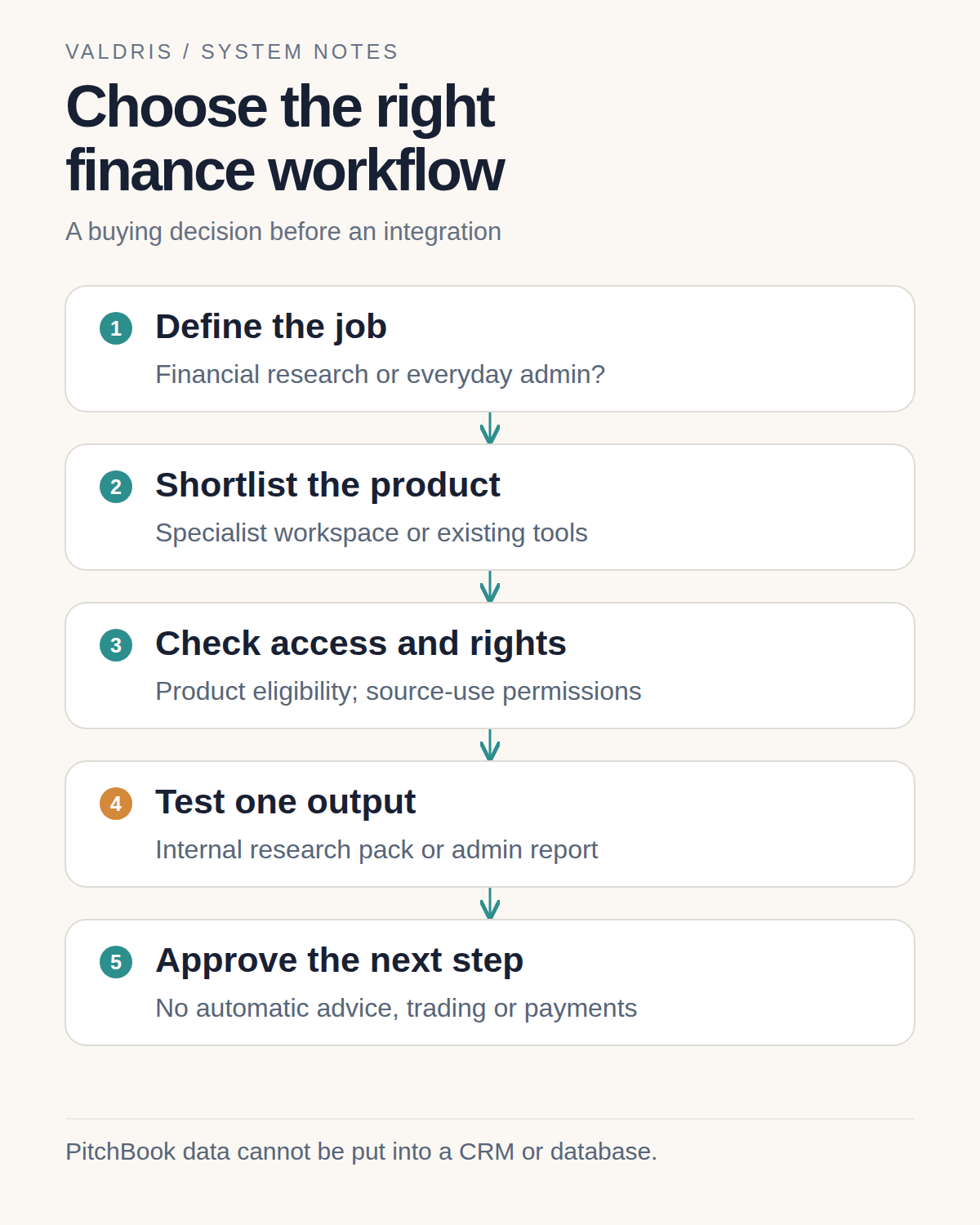
Specialist research and everyday finance administration need different buying decisions.
What about an ordinary small or medium business?
Most businesses do not need investment-banking datasets to understand overdue invoices, prepare a monthly management pack or find gaps in job paperwork.
For those jobs, the better starting point may be the accounting platform, CRM and documents the company already owns, connected through their supported APIs and existing permissions. For example, a read-only export of overdue invoices could support an internal exception report, with a finance team member deciding what to do next.
That would be a separately designed business automation, not a claimed feature of ChatGPT for Financial Services. We would assess the available tools, privacy requirements and cost before choosing between ordinary automation, a short model call and an agent-based workflow.
Our recommendation is to buy the specialist workspace when its research data and financial-document tools solve a real need. For everyday finance administration, prove that the specialist plan adds enough value before paying for it.
Costs and controls to settle before a pilot
OpenAI does not publish a Financial Services list price in the launch announcement or help guide. Pricing is discussed with Sales. We would not substitute a standard ChatGPT Enterprise figure or the Agents API’s token rates for that quote.
Ask for the complete workspace cost, included model usage, source limits, any overage terms and separate provider subscriptions. Then include setup, template configuration, training, review time and ongoing support in the business case.
The product includes Enterprise controls such as SAML single sign-on, SCIM provisioning, role-based access and configurable retention. Business data is not used to train models by default. Those controls still need configuring, and “not used for training” does not mean “never stored”.
For a regulated firm, the pilot should have named business, compliance and data owners. Confirm data location, contractual terms, recordkeeping and information barriers for the proposed workspace. The separate Agents API’s residency rules should not be assumed to describe this product.
We would exclude autonomous trading, lending decisions, payments and unreviewed client advice from the first scope. OpenAI describes the product as a tool for research, not financial or investment advice.
Bring one research or reporting bottleneck
A useful first pilot has approved inputs, one named output, a reviewer and a stopping rule. Run it repeatedly, compare it with today’s process and record the corrections as well as the time saved.
If you are considering ChatGPT for Financial Services, bring us a real example of the work your team repeats. We can map the handoffs, check which integrations and data rights are available, and agree a bounded workflow to test.
Book a free 30-minute fit call with Valdris.
Product information checked on 11 September 2026. Proposed integrations require scope, access and licensing checks. This article is operational guidance, not financial, investment or legal advice.