

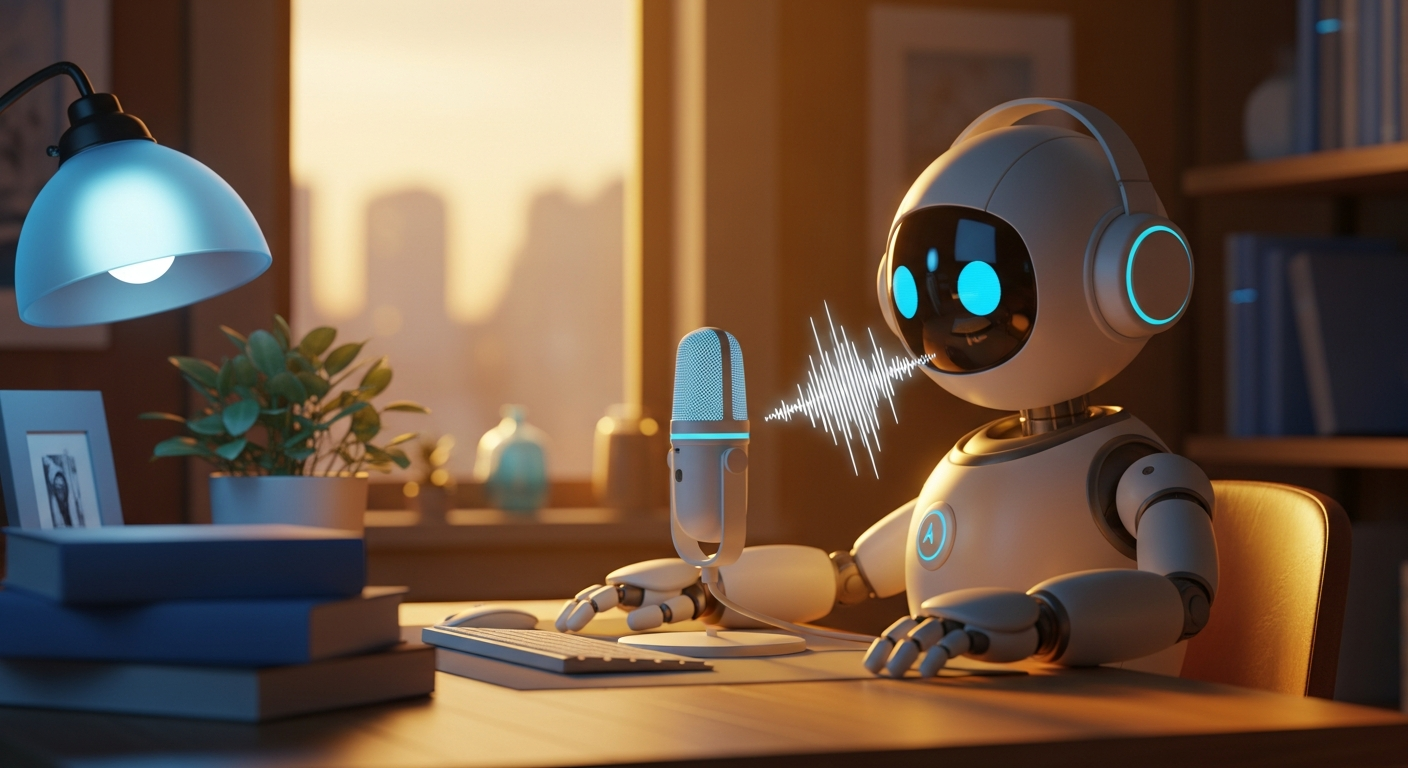
I caught myself doing something genuinely weird yesterday. I was pacing around my home office, talking out loud to an empty room, gesturing wildly with my hands, and arguing with my computer about how a landing page should function.
"No, make the hero section darker," I said to nobody in particular. "Move the email capture above the fold. Actually, scrap that, let's use a dynamic grid layout for the features, and make the hover states pop with a neon blue."
I stopped talking. Two seconds later, the code on my screen updated, and the live preview morphed exactly into what I had just described.
I hadn't touched my keyboard once.
The Death of the Keyboard Prompt
Typing out AI prompts is suddenly starting to feel incredibly slow. It feels like the dial-up internet of the AI era.
For the last two years, we've been hunched over our glowing rectangles, carefully typing out instructions, trying to perfectly engineer our text prompts to get ChatGPT or Claude to do what we want. But the technology has crossed a massive threshold in the last few months. Voice-to-text AI is no longer the clunky, frustrating Siri-style dictation where you have to awkwardly say "comma" and "new paragraph" just to get a coherent sentence.
Top builders and creators are moving entirely to a voice-first workflow.
They are using insanely fast, locally-run dictation tools like SuperWhisper, combined with AI-native IDEs like Composer or Cursor. You press a hotkey, talk naturally at full speed, release the key, and your messy, rambling thoughts are instantly transcribed with perfect punctuation and fed directly into the AI's context window.
Why This Matters for the Solo Empire
If you are a solo creator, a founder, or building a personal brand, your absolute biggest bottleneck is leverage.
You are constantly trying to collapse the distance between having an idea and shipping that idea.
The average person types around 40 to 60 words per minute. But you speak at about 150 words per minute. When you are forced to type out complex logic for a new software tool you're building for your audience, or when you are outlining a massive video essay, the keyboard acts as a friction point. It forces you to slow down, edit yourself mid-sentence, and lose your train of thought.
When you switch to voice, that friction disappears. You aren't typing; you are directing. You are brain-dumping pure logic, and letting the machine handle the syntax, the structure, and the execution.
The Voice-First Playbook
Here is what this shift actually looks like in practice, and how it changes the way we build:
1. The "Think Aloud" Product Builder You no longer need to know React or Python to build a mini-app or a lead-gen tool for your audience. You just need to know how to explain what you want. By piping SuperWhisper into Composer, you can literally talk your software into existence. You can say, "I want a clean calculator tool that lets creators plug in their YouTube views and spits out estimated AdSense revenue. Make it look like Stripe's website." The AI builds the V1 while you go grab a coffee.
2. The Unfiltered Content Engine Staring at a blinking cursor is paralyzing. Pacing around a room and ranting about a topic you care about is natural human behavior. If you are outlining a massive video essay or a flagship newsletter, voice-to-text captures the raw energy, the natural pacing, and the conversational tone that makes content actually good. You skip the "blank page" phase entirely and jump straight into editing a fully fleshed-out draft.
3. The End of the Translation Tax When we type, we unconsciously pay a "translation tax." We try to translate our messy human thoughts into structured, formal text that we think the computer will understand. Voice AI is now smart enough that you don't have to do this. You can ramble, backtrack, correct yourself mid-sentence ("Wait, no, don't use a database for this, just save it to local storage"), and the LLM perfectly understands your underlying intent.
4. Articulation is the New Syntax Coding used to be about memorizing syntax. Writing used to be about grammar. Now, the highest-leverage skill a creator can have is simply articulation. The better you get at verbally explaining your vision, your logic, and your constraints out loud, the faster you can build massive projects entirely on your own.
The Director's Chair
We are entering an era where the best creators aren't the fastest typists, the most disciplined writers, or the most technical coders.
They are the best directors.
The keyboard is rapidly becoming optional for the heavy lifting of creation. The tools are ready. The latency is practically zero. The only question left is: what are you going to build when the only limit is how fast you can talk?