

Scroll X for five minutes right now. I guarantee you’ll pass at least three people calling themselves an “audience builder,” two folks launching a “hyper-growth” newsletter, and one guy promising to teach you how to make $10k a month by ghostwriting for other people who want to make $10k a month.
It’s a digital snake eating its own tail.
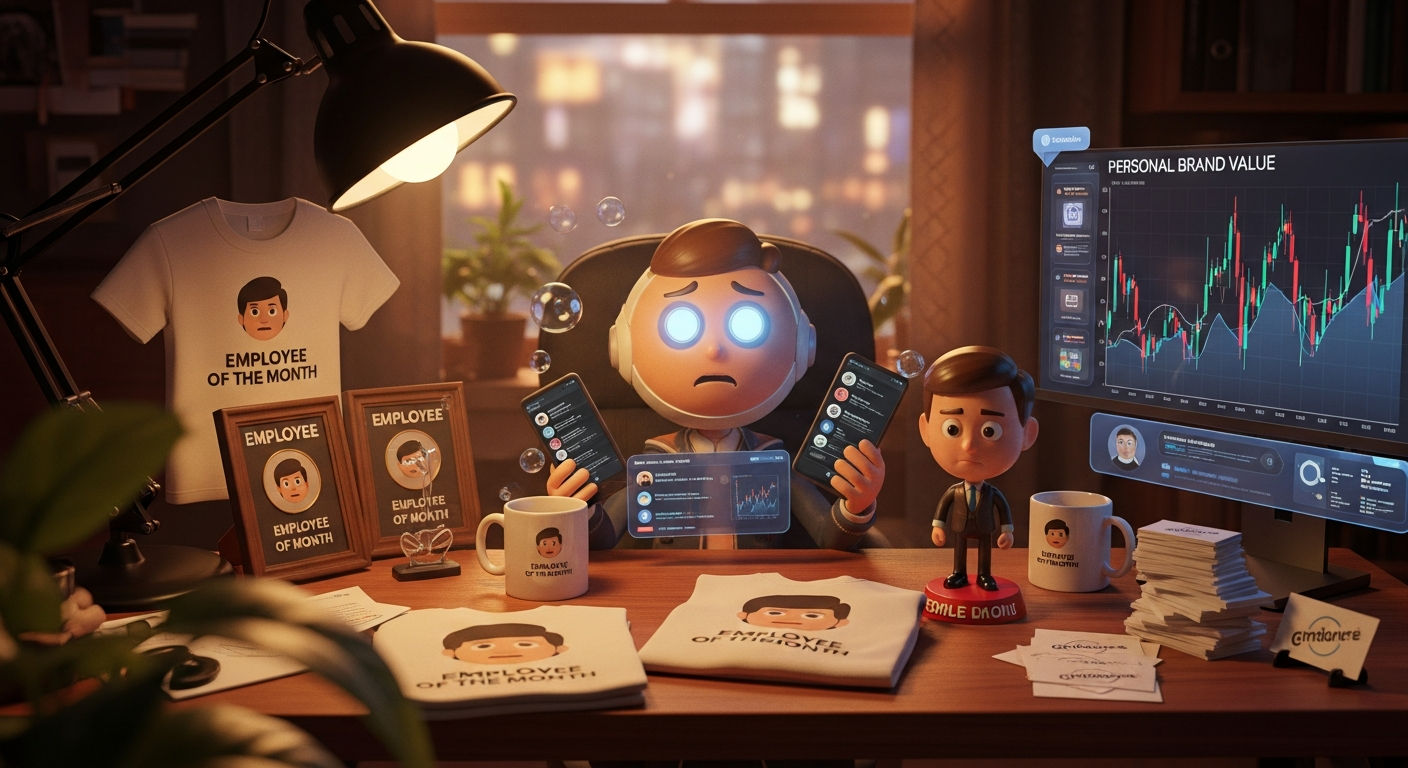
Recently, a sentiment has been bubbling up on my timeline: Personal branding is the 21st-century dot-com bubble.
Honestly? I think they’re absolutely right.
The Rise of the Platitude Poster
What exactly changed? Over the last few years, the barrier to entry for content creation dropped to zero just as the financial upside skyrocketed. During the pandemic, everyone realized the massive leverage of having an audience.
But instead of building an audience around a specific, hard-earned skill, the "skill" simply became building the audience itself.
We entered an era of peak engagement bait. We got endless threads full of Wikipedia summaries. We got platitudes disguised as profound business advice. We got people with zero operating experience selling courses on how to operate businesses.
The market is now completely saturated with noise. Everyone added "Founder | Audience Builder | Newsletter Operator" to their bio, but very few are actually building anything of substance.
Why the Crash is a Good Thing
The critics aren't wrong. A massive correction is coming.
You can already feel it happening. Audiences are developing a built-in spam filter for the fake hype. Algorithms across LinkedIn and X are tweaking their dials to punish blatant engagement farming and reward original thoughts.
The bubble is going to burst for the platitude-posters. But here is the good news: That is exactly what we should want.
Think back to the dot-com crash of 2000. When the bubble burst, it brutally wiped out the companies that had a ".com" in their name but no actual business model (RIP Pets.com). But that exact same crash cleared the runway for Amazon, Google, and the titans of the modern internet to take over.
The creators who survive this impending correction are going to build absolute empires.
The question is: how do you make sure you’re building the next Amazon, and not just another Pets.com?
How to Build a Crash-Proof Personal Brand
If you want to survive the creator economy correction, you have to pivot from engagement farming to actual competence. Here is how you do it.
1. Build on actual competence, not just curation. Anyone can feed a Huberman podcast into ChatGPT and post the top ten takeaways. That’s a commodity. A crash-proof brand is built on your specific, lived experience. Don’t tell me how to build a SaaS; show me the exact cold email template you used to land your first ten customers, complete with the embarrassing typos. Competence is the ultimate moat.
2. Stop playing the algorithm’s game. If your entire strategy relies on a platform’s current algorithm favoring carousel posts or long-form text, you are a tenant farmer. The landlord can change the rules at any second. Use social platforms like X and LinkedIn as a top-of-funnel discovery engine, but aggressively move your true fans to a platform you own. Start a newsletter. Host a private community. Own your distribution.
3. Have a real backend. If X or LinkedIn disappeared tomorrow, do you still have a business, or do you just have a dopamine addiction? The personal brand shouldn’t be the business; it should be the marketing arm for the business. Sell a real service, a software product, consulting, or a highly specific digital product that solves a painful problem for a specific group of people.
4. Embrace your weirdness. The algorithmic middle is incredibly crowded. The edges are wide open. The more you try to sound like every other "thought leader" on the timeline, the faster you'll be replaced by AI. Lean into your specific tone of voice, your weird hobbies, and your contrarian opinions. Authenticity isn't just a buzzword; it's a survival mechanism in a sea of AI-generated sameness.
The Bubble is the Opportunity
The personal branding bubble is going to pop. The engagement bait will dry up. The copycats will get bored and move on to the next get-rich-quick scheme.
And when the dust settles, the only ones left standing will be the people who actually have something real to say.
When the engagement bait stops working, what will you actually be known for? Are you building a brand that can survive the crash, or are you just riding the bubble?