

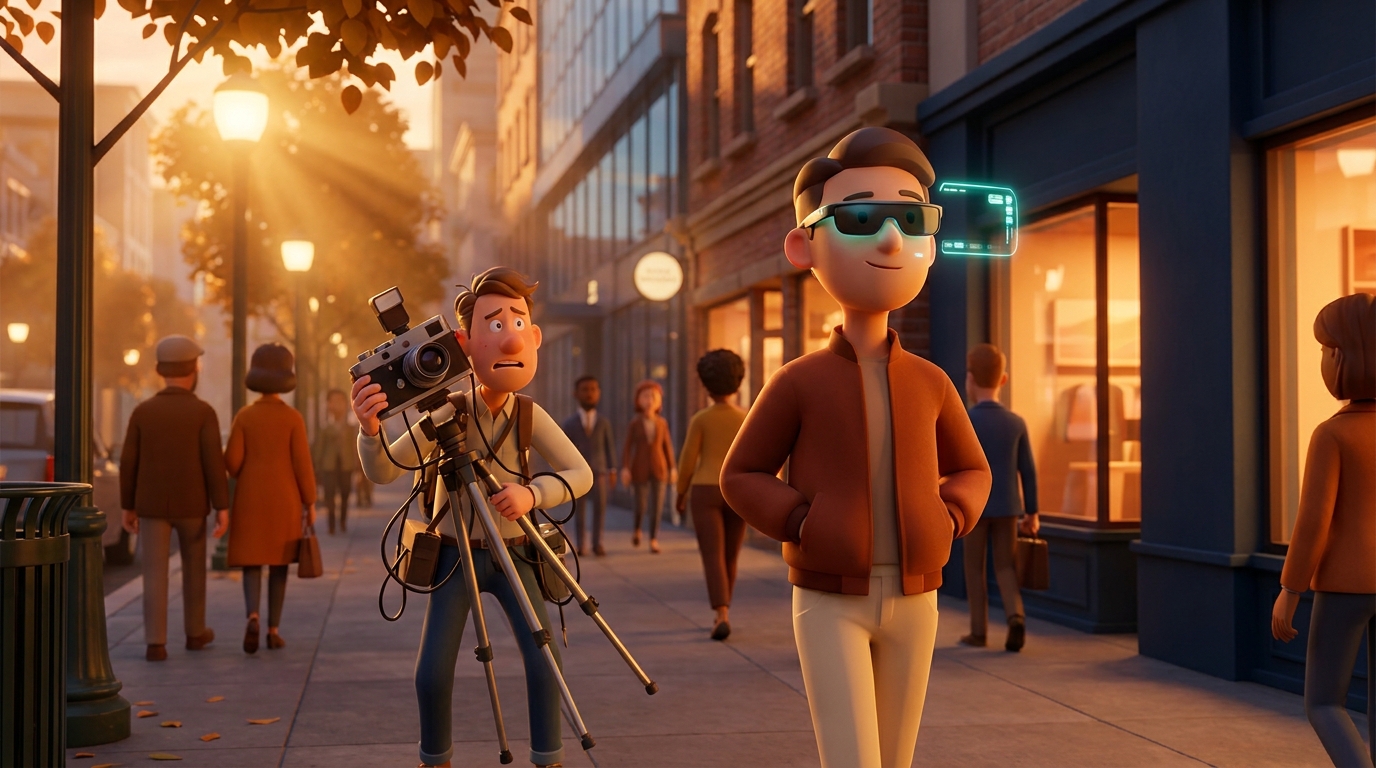
I was scrolling Twitter last week when I saw something that made me stop dead: Anduril (Palmer Luckey’s defense tech company) is partnering with Meta to build AR smart glasses for soldiers.
We're talking advanced eye-tracking, real-time threat detection HUDs, and seamless voice commands running on lightweight frames. Most people read that and saw a dystopian military-industrial complex headline.
I saw something else entirely.
I saw the death of the vlogging camera.
Think about it. Military tech always trickles down to consumers. GPS. The internet. Duct tape. If soldiers are getting lightweight, high-res, voice-activated glasses that can stream and process visual data in real-time... how long until creators get the consumer version?
My hot take is that within three years, the biggest personal brands won't be holding a camera on a stick. They’ll be streaming ultra-HD POV content straight from their faces. If you are a creator, founder, or personal brand, you need to start preparing for this shift right now.
Here is why this military tech is going to completely kill the smartphone vlogging era.
🥽 The Death of the "Setup"
Right now, being a creator looks ridiculous in public.
You walk around with a heavy mirrorless camera on a GorillaPod, or you hold your iPhone at arm's length while shouting into a clipped-on DJI mic. It's friction. It's unnatural. It separates you from the environment you are trying to capture.
Smart glasses remove the hardware barrier between you and the content. You see a thing, you speak a command, you capture it. No setting up a tripod. No checking your framing.
When the friction of creation drops to zero, the volume of content explodes. The people who win won't be the ones with the best cinematic color grading; they will be the ones who capture the most authentic, in-the-moment insights.
🎙️ Audio-First Workflows Are Mandatory
If you're wearing glasses, you aren't tapping a screen. You're talking.
The future of wearable content creation relies heavily on voice commands and audio processing. We are already seeing this with the current generation of Ray-Ban Meta glasses. You don't pull out your phone to write down an idea; you dictate it.
I've already started shifting my workflow to be audio-first to prepare for this. Instead of typing out blog post ideas, I dictate them while walking, and route them through an automation that parses my thoughts.
// n8n Code Node: Parse raw audio transcript from an iOS Shortcut / Wearable into structured content ideas
const transcript = $input.item.json.body.text;

// Simple regex to extract action items vs content thoughts using spoken wake words like "Idea:" or "Task:"
const ideas = transcript.split(/(?i)idea:/).slice(1).map(i => i.trim());
const tasks = transcript.split(/(?i)task:/).slice(1).map(t => t.trim());

return {
  json: {
    original_transcript: transcript,
    content_ideas: ideas.length > 0 ? ideas : ["No specific ideas tagged"],
    action_items: tasks.length > 0 ? tasks : ["No tasks tagged"],
    word_count: transcript.split(' ').length,
    timestamp: new Date().toISOString()
  }
};
I run this exact snippet in n8n to catch voice notes sent from my phone while I'm out. Notice how it relies on spoken "wake words" (like literally saying out loud, "Idea:") rather than complex AI—when you're building audio-first workflows, keep the parsing logic dead simple so it doesn't break when the transcription gets slightly mangled.
👁️ The Shift to POV Storytelling
For the last ten years, video content has been "face-to-camera." You are the subject, and the audience is watching you.
AR glasses flip the script. The audience is no longer watching you; they are being you. They see what you see. They look where you look. This is a massive psychological shift in how we consume content.
"The creators who win the next decade won't be the ones with the best studio lighting. They'll be the ones who make you feel like you're standing right next to them."
We are already seeing this trend on TikTok and Reels. POV videos perform incredibly well because they feel immersive and native to the platform. When glasses become the primary recording device, POV won't just be a trend—it will be the default format of the internet.
🚀 What You Should Do Today
You don't need to wait for Meta and Anduril to release consumer-grade combat glasses to adapt to this shift.
Start practicing POV storytelling today. Next time you film a tutorial, a day-in-the-life, or a breakdown of your work, stop pointing the camera at your face. Point it at what you are doing. Narrate your actions. Make the viewer the protagonist of the video.
And start building your audio-to-text pipelines. Get comfortable dictating your ideas, formatting them with voice commands, and letting automation handle the rest.
The era of the heavy camera rig is ending. The question is: are you ready to go hands-free?