

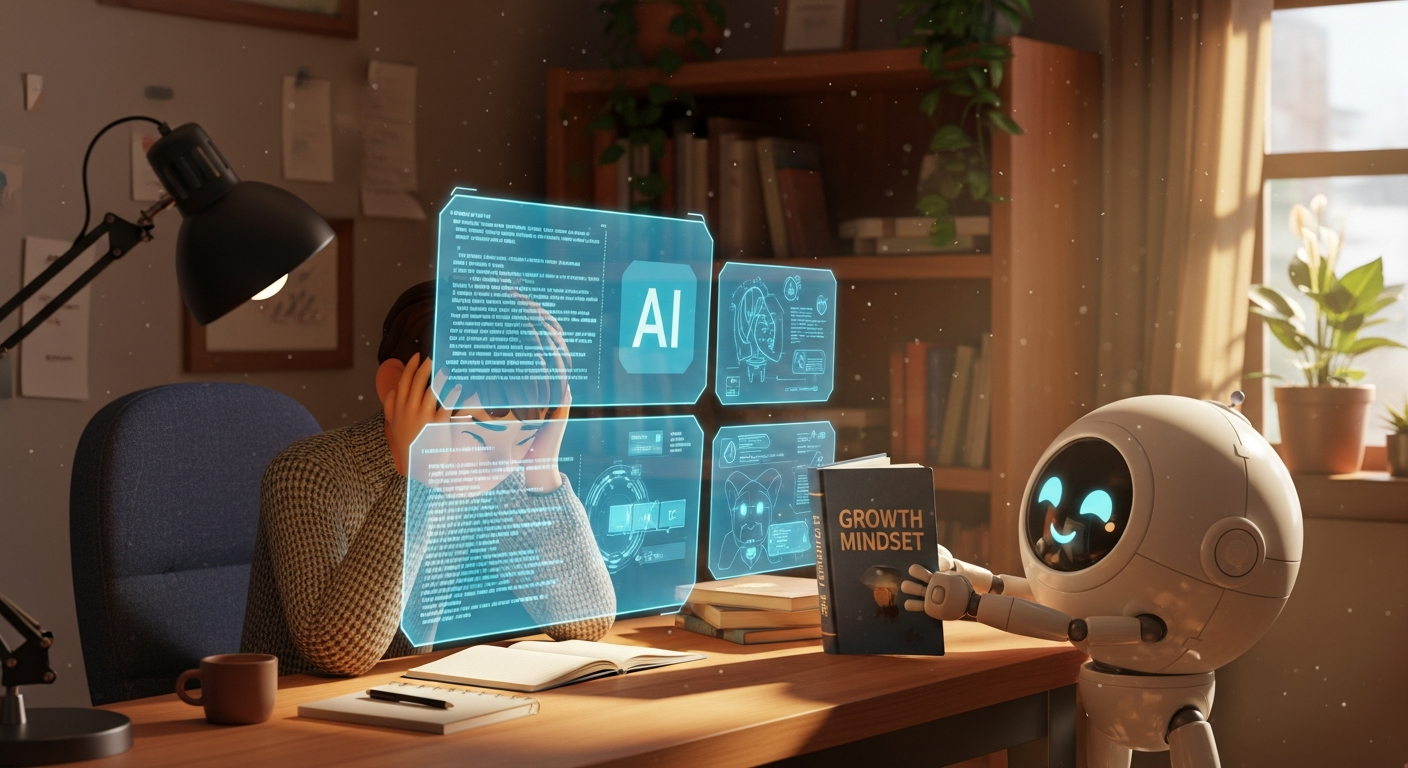
I have had a strange six months.
On paper, AI should have made me excited. I work in product. I care about better tools, better workflows, and finding smarter ways to build things.
But if I am honest, it also made my imposter syndrome louder.
A lot of the work I do every week is exactly the kind of work AI is suddenly good at. Writing up notes. Turning messy conversations into structure. Drafting tickets. Rewording requirements. Summarising decisions. Cleaning up the admin that gathers around product work.
When a tool starts doing that faster than you, and sometimes better than you, it raises an uncomfortable question.
What am I actually here for?
I do not think that question is a bad thing anymore. I think it might be the point.
The fear is real
A lot of AI writing still sounds too neat. It tells people not to worry, as if anxiety is just a branding problem.
I do not buy that.
The anxiety is real because AI is no longer a toy that writes funny poems and awkward emails. It can plan, summarise, design, code, research, analyse, test ideas, write documentation, build prototypes, and produce first drafts of things that used to take hours.
For a lot of people, that is not abstract. It hits the work they do every day.
It also hits something deeper than the work. It hits identity.
People are not only asking, "Will AI take my job?" They are asking, "If AI can do this, what makes me useful?"
That is a harder question. And pretending it is silly does not help anyone.
AI attacks tasks before job titles
The mistake is thinking about this only in terms of whole jobs disappearing.
Most jobs are bundles of tasks. Some tasks are repetitive. Some need judgment. Some need taste. Some need trust. Some need context that lives in conversations, politics, customers, tradeoffs, and messy human reality.
AI does not usually replace a whole job in one clean move. It eats into tasks.
For product managers, that might mean:
- turning meeting notes into actions
- writing the first version of a ticket
- generating acceptance criteria
- summarising stakeholder feedback
- creating a draft roadmap update
- cleaning up a messy requirements doc
- comparing user research themes
Those things matter. They keep the machine moving.
But they are not the whole job.
And if I am being honest, they can also become a hiding place.
Jira-shaped work is still work, but it is not the point
Product work can quietly become Jira-shaped.
You write tickets. You groom the backlog. You update statuses. You prepare notes. You keep boards tidy. You turn fuzzy conversations into artefacts that look like progress.
There is value in that. Teams need clarity. Engineers need context. Stakeholders need updates.
But a ticket is not the product.
A clean backlog is not customer value.
A meeting summary is not progress on its own.
AI forced me to admit something uncomfortable: a lot of the work I was stressing over was output, not impact.
That does not mean the work was pointless. It means I had started using visible output as proof that I was valuable.
That is where the imposter syndrome got loud.
If AI can draft the ticket, summarise the call, structure the notes, and reword the requirements, then I cannot hide behind those things as easily.
I have to ask the scarier questions.
Are we solving the right problem?
Have we tested this properly?
Do stakeholders actually agree on the outcome, or are we just aligned on the wording?
Would a prototype show that the idea is weaker than we think?
That is harder work. It is also better work.
The job moves up a level
The more I use AI, the more I think the product manager role has to move up a level.
Less ticket factory. More sense-maker.
Less "can you write this up?" More "should we be doing this at all?"
Less admin theatre. More testing, prototypes, stakeholder conversations, and actual improvements.
AI can write the first version of the ticket. It cannot tell me whether the thing is worth building.
It can summarise a conversation. It cannot fully read the room.
It can turn notes into a plan. It cannot take responsibility for the tradeoff.
It can help me prototype faster. It cannot decide whether the prototype proved anything useful.
That is where the human work lives.
Not in pretending we are faster than the machine at admin. We are not.
The human work is judgment, context, taste, relationships, responsibility, and the courage to ask better questions.
What AI has actually freed me to do
Once I got past the first wave of threat response, I started to notice something else.
AI was giving me room.
Room to prototype ideas I would previously have left in my notes.
Room to test assumptions earlier.
Room to walk into stakeholder conversations with something more useful than another status update.
Room to explore improvements instead of just maintaining the process around improvements.
That last bit matters.
A lot of teams spend huge amounts of energy managing the container around work: boards, updates, docs, meeting notes, prioritisation theatre. Some of that is necessary. Too much of it becomes a tax.
AI helps reduce that tax.
If I can get help turning a messy conversation into a clean first draft, I can spend more time asking whether the conversation uncovered the right thing.
If I can get help creating a quick prototype, I can test the idea before we turn it into three weeks of delivery.
If I can get help summarising stakeholder feedback, I can spend more time noticing where people disagree.
That is not AI replacing the job. That is AI removing friction from the parts of the job that were swallowing the rest.
Output is not the same as value
This is the part I keep coming back to.
AI is very good at output. Sometimes too good.
It can create a plan that looks sensible. It can write a clean document. It can produce a polished deck. It can make messy thoughts look finished before they have been properly tested.
That is useful, but also dangerous.
Because output can trick us into thinking we have done the work.
The value is not the document. The value is whether the document helps people make a better decision.
The value is not the prototype. The value is whether the prototype teaches us something before we spend real money.
The value is not the meeting summary. The value is whether it captures the decision, the disagreement, and the next move.
The value is not the AI-generated answer. The value is what we do with it.
A simple way to reframe the threat
The most useful framework I have found is simple: replace, reduce, raise.
Replace
What can AI take off your plate completely?
This is the low-value repetitive stuff. First drafts. Summaries. Formatting. Template creation. Admin cleanup. The work that needs doing but does not need your best thinking every time.
Reduce
What can AI help you do faster, while you still own the final output?
This is where most professional work sits. Proposals, specs, research notes, presentations, stakeholder updates, analysis, planning, content, documentation.
You still review it. You still bring the context. You still decide what is good enough.
But you do not start from zero.
Raise
What can AI help you do at a higher level than before?
This is the exciting part.
Can you build a prototype you could not build before?
Can you test an idea earlier?
Can you learn a skill faster?
Can you compare options more clearly?
Can you have a better conversation because you walked in with a clearer model of the problem?
That is where AI becomes leverage instead of just automation.
Using AI to 10x your life without becoming a productivity robot
I do not love the phrase "10x your life" when it gets used as hustle-bro nonsense.
But there is a grounded version of it that I do believe in.
AI can reduce the friction between having an intention and doing something with it.
Want to learn something? Use AI as a tutor.
Want to change job? Use it to map the skill gap, improve your CV, practise interviews, and build a portfolio plan.
Want to get healthier? Use it to draft meal plans, routines, shopping lists, and habit reviews. Not as a doctor. As a planning assistant.
Want to start a business? Use it as a researcher, copywriter, analyst, critic, and first-draft machine.
Want to create more? Use it to get past the blank page, explore angles, storyboard ideas, and turn rough thoughts into something you can shape.
The danger is using AI to avoid thinking.
The opportunity is using it to think more clearly, move faster, and attempt things that used to feel out of reach.
The risk is real, but opting out is not protection
I do not want to make this sound softer than it is.
Some work will disappear. Some tasks will be worth less. Some companies will use AI badly. Some people will over-trust it. Some leaders will use it as an excuse to cut before they understand what they are cutting.
There are privacy issues, bias issues, quality issues, and a very real risk of people losing confidence in their own skills because the machine is always there with a polished first answer.
But opting out does not protect you from those risks.
It just gives you less agency.
The better move is to understand the tool, use it deliberately, and become clearer about where your value actually lives.
What I would do this week
If you are feeling anxious about AI, do not start with a giant transformation plan.
Start smaller.
List the work you do in a normal week.
Mark the tasks that are repetitive, text-heavy, research-heavy, admin-heavy, or mostly first-draft work.
Pick one per day and try AI on it.
Do not blindly accept the result. Review it. Edit it. Ask what it missed. Notice where it helped and where your judgment mattered.
Then use the saved time for one thing that actually moves the work forward.
Have the stakeholder conversation.
Build the rough prototype.
Test the assumption.
Ask the uncomfortable question.
Write the clearer strategy.
Make the thing easier for the team.
That is the shift.
Not AI instead of you.
AI clearing enough space for you to do the work you were probably meant to be doing in the first place.
The uncomfortable gift
AI made some parts of my job feel less special. I will not pretend that was comfortable.
But it also reminded me which parts were actually important.
Maybe the goal is not to defend every task we used to do.
Maybe the goal is to become more honest about which tasks were never the point.
If AI can take some of the grunt work, the question becomes what we do with the space it creates.
More admin?
Or better conversations, better testing, better prototypes, better decisions, and better lives?
That feels like the place to start.